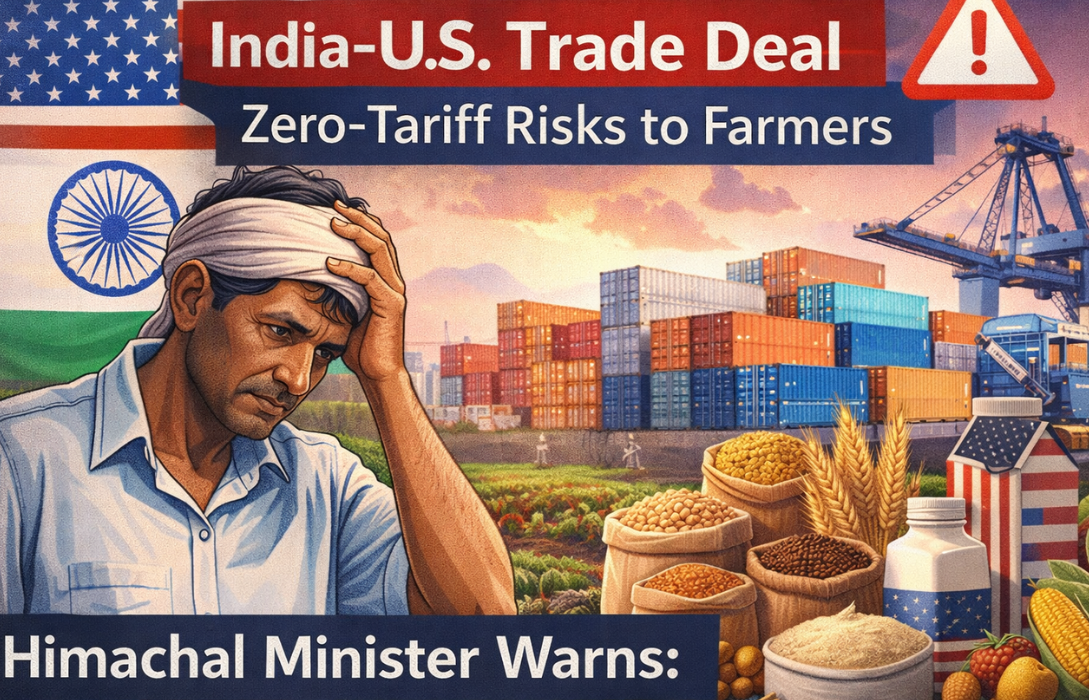
Himachal Pradesh’s Public Works and Urban Development Minister, Vikramaditya Singh, has raised concerns about the proposed India-US trade agreement. He warned that zero tariffs on agricultural imports could harm the incomes of Indian farmers and affect rural livelihoods.
Zero-Tariff Imports Pose Risk to Farmers
On January 31, 2026, Singh said allowing American agricultural products into India at minimal or zero duty would put the country’s farming sector at risk. He emphasized that most Indian farmers are small and marginal, making them unable to compete with the heavily subsidized farming in the US.
He stated, “If the government signs such an agreement without consulting farmers, holding parliamentary debates, or seeking input from stakeholders, it would betray crores of Indian farmers, horticulturists, and laborers.”
Impact on Agriculture and Rural Economy
Singh explained that zero-tariff imports of grains, pulses, oilseeds, fruits, vegetables, and dairy could:
-
Lower domestic prices
-
Reduce farmers’ incomes
-
Increase rural unemployment
He warned that sensitive sectors like dairy and select agricultural products may suffer under foreign pressure. Singh criticized the Central Government for not publishing the official draft or clarifying which products would have zero tariffs. He said this leaves farmers vulnerable, especially with rising costs and unpredictable weather.
Call for Transparency and Dialogue
Singh urged the government to consult Chief Ministers, farmers’ unions, and agricultural experts before finalizing the deal. He said, “Decisions affecting farmers should not be made in secret or announced abroad. Farmers must have a voice in policies that affect their livelihood.”
He warned that without clear guidelines and open dialogue, the agreement could hurt farmers’ incomes, food security, and rural stability.
Government Response on Agricultural Safeguards
In response, Commerce and Industry Minister Piyush Goyal reassured that Prime Minister Narendra Modi has protected agriculture and dairy sectors in the trade agreement.
Goyal said, “The deal safeguards sensitive sectors and encourages exports, technology adoption, and global investments. It also creates jobs for millions in labor-intensive industries.”
He added that stakeholders from technology, exports, and MSMEs are optimistic. They see the agreement as a way to integrate into global supply chains while supporting domestic growth.
Conclusion
The India-US trade deal has sparked debate over balancing global trade commitments and farmers’ interests. Himachal Pradesh’s warnings highlight the need for transparency, stakeholder consultation, and protective measures to secure Indian agriculture and rural livelihoods.