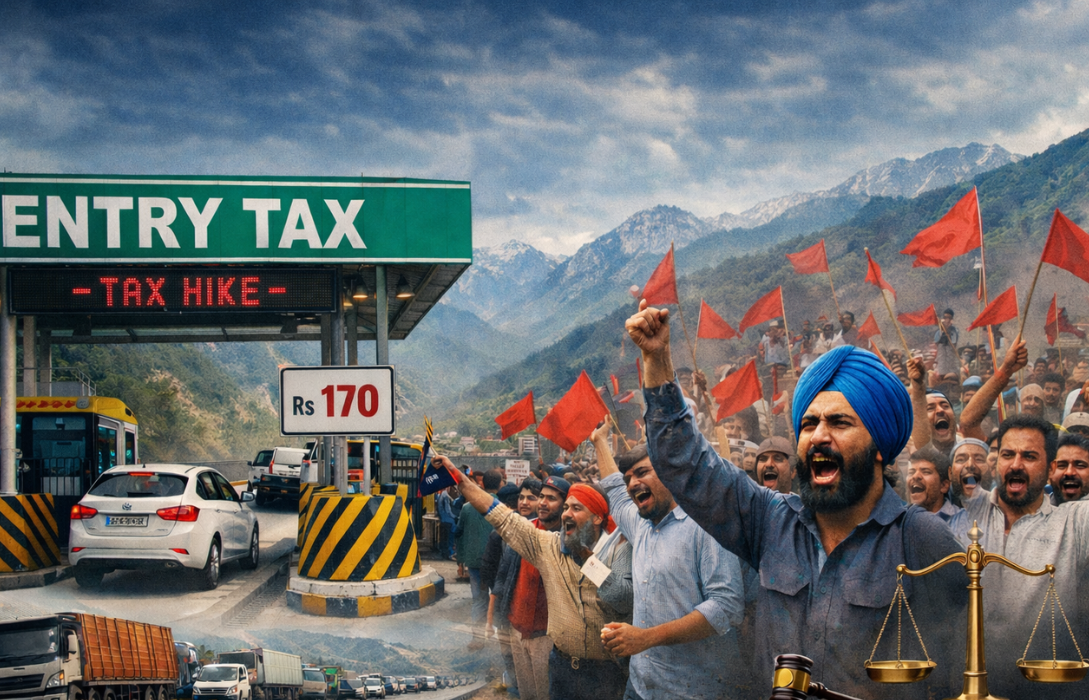
The Himachal Pradesh Government has announced a significant entry tax hike, leading to strong reactions in Punjab’s border districts. The revised rates will come into effect from April 1, 2026, increasing charges for both local commuters and vehicles coming from other states.
Under the new structure, the tax for local residents will rise from Rs 70 to Rs 100. For five-seater vehicles registered outside Himachal Pradesh, the entry fee will jump from Rs 70 to Rs 170. Meanwhile, commercial vehicles may see an increase of up to Rs 800, placing additional pressure on transport operators and traders.
Sharp Reaction from Punjab Border Residents
Residents living in Punjab areas bordering Himachal Pradesh have expressed serious concerns over the decision. Many people commute daily for work, trade, and business, and the new tax rates are expected to increase their monthly expenses substantially.
Paramjit Singh Pamma, a municipal councillor from Nangal and former president of the District Bar Association, described the move as “illegal and unfair.” He stated that Himachal Pradesh is the only state currently imposing such an entry tax on vehicles registered in other states.
According to him, the hike represents nearly a 30 percent increase for people living near the border and almost 150 percent more for visitors from other regions. Daily commuters may now have to spend nearly Rs 4,000 per month, which could seriously impact middle-class families and small business owners.
Demand for Reciprocal Action by Punjab Government
In June 2025, the Nangal Municipal Council passed a unanimous resolution proposing a reciprocal tax on vehicles registered in Himachal Pradesh. The idea was to discourage unilateral tax increases and protect local residents from financial strain.
However, Punjab authorities have not yet taken any action on the proposal. Local leaders are now urging the Punjab Government to clarify its position and safeguard the interests of border-area residents.
Legal Challenge in Himachal High Court
The matter has also reached the legal stage. Advocate Uttansh Monga has filed a petition in the Himachal Pradesh High Court, challenging the validity of the entry tax.
He argues that imposing entry tax on vehicles using national highways is unconstitutional and amounts to double taxation, as commuters already pay toll charges to the National Highways Authority of India (NHAI).
Citing information obtained through an RTI application, he claimed that Himachal Pradesh collects around Rs 150 crore annually from vehicles registered in other states.
Economic Concerns and Possible Revenue Motive
Sources suggest that the tax revision may be an attempt by Himachal Pradesh to compensate for the reduction in Revenue Deficit Grant (RDG) funds. However, experts warn that the decision could negatively affect local businesses, tourism, and GST collections in border regions.
Residents of Ropar district are planning protests and meetings with their elected representatives to raise their concerns. Many fear that the move could disrupt trade relations between Punjab and Himachal Pradesh and create long-term economic challenges.
Conclusion
The Himachal Pradesh entry tax hike has become a major issue for people living along the Punjab border. With higher costs for commuters and commercial operators, the decision has sparked political, legal, and public opposition. As the implementation date approaches, all eyes are now on the courts and state governments to see how the matter unfolds.