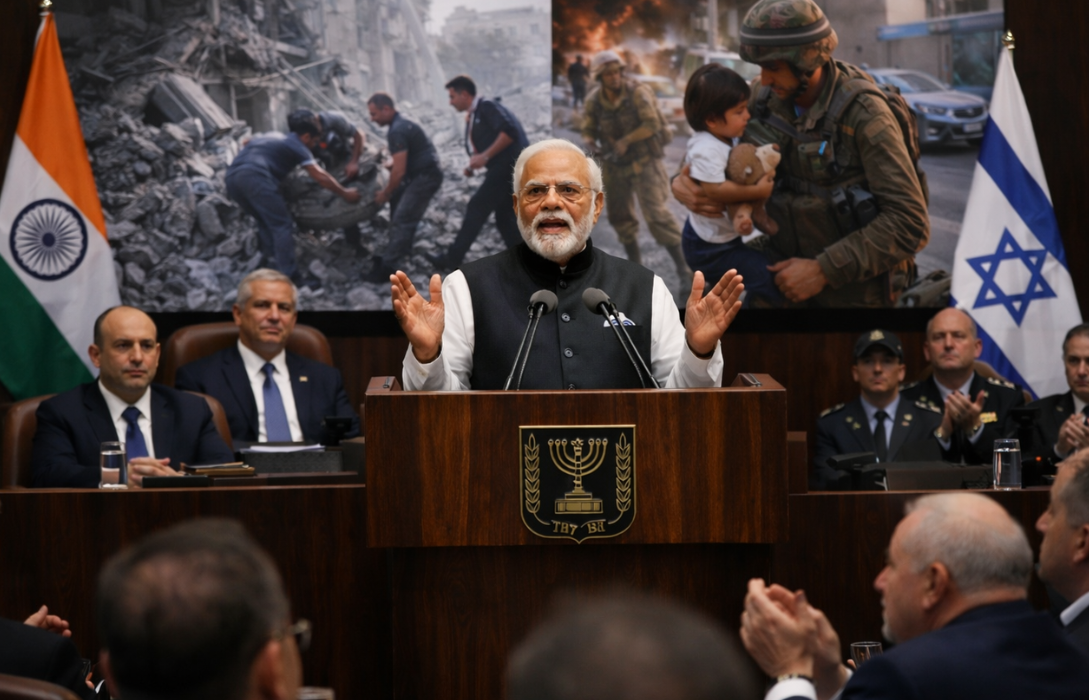
Indian Prime Minister Narendra Modi addressed the Knesset on February 25, 2026, marking the first time an Indian leader has spoken in Israel’s parliament. During his speech, Modi reaffirmed India’s support for Israel while highlighting the importance of protecting civilians in conflict zones.
India Stands Firm with Israel
Modi condemned the October 7, 2023 attacks by Hamas fighters as “barbaric” and stated, “No cause can justify the killing of civilians.” He expressed India’s continued support for Israel, noting that the two nations share a strong strategic partnership.
Welcoming Modi at Ben Gurion Airport, Israeli Prime Minister Benjamin Netanyahu described the Indian leader as “more than a friend, a brother” and praised India for standing by Israel in recent crises.
Focus on Peace and Regional Stability
While supporting Israel, Modi also highlighted India’s endorsement of the Gaza peace initiative approved by the United Nations Security Council in November 2025. He called the initiative a promising framework for achieving just and lasting peace in the region.
The Prime Minister referred to India and Israel as trusted partners, contributing to global stability and economic growth. He also emphasised cooperation in trade, security, artificial intelligence, and quantum technology, and pledged to strengthen collaboration across multiple sectors.
Historic India-Israel Relations
Modi’s visit is the first since his 2017 trip, which followed a period of warming ties after his 2014 election. Netanyahu previously visited India in 2018. The two nations have consistently expanded defence and trade relations, with India being Israel’s largest arms buyer, spending $20.5 billion between 2020 and 2024. In 2024, bilateral trade reached $3.9 billion, largely centred on defence and security.
Criticism and Domestic Reactions
Modi’s support for Israel has drawn criticism amid the ongoing conflict in Gaza, which has resulted in over 72,000 deaths and 171,000 injuries. Indian opposition leaders, including Imran Masood of the Congress party and Marian Alexander Baby of the Communist Party, urged Modi to address the humanitarian crisis and reaffirm India’s historic support for Palestinian rights.
Masood highlighted the need to acknowledge the loss of civilian lives, particularly children, while Baby described Modi’s stance as a potential departure from India’s long-standing anti-colonial and pro-Palestinian position, consistent with UN resolutions co-sponsored by India.
Strengthening Strategic and Technological Ties
Despite domestic criticism, Modi underscored the vital nature of India-Israel relations. The two nations continue to collaborate in defence, technology, and trade, viewing the partnership as crucial for regional stability and mutual growth.